Investing in the Foundations of Tomorrow's Economy
How real assets are shaping a more resilient world
Executive Summary
Every investment era has an organizing belief. The last one favored efficiency: global supply chains, lean inventories, low-cost capital and businesses that could scale without owning much of the physical world. The next one is likely to favor resilience: secure inputs, reliable power, durable infrastructure, strategic locations and assets that keep economies functioning under stress.
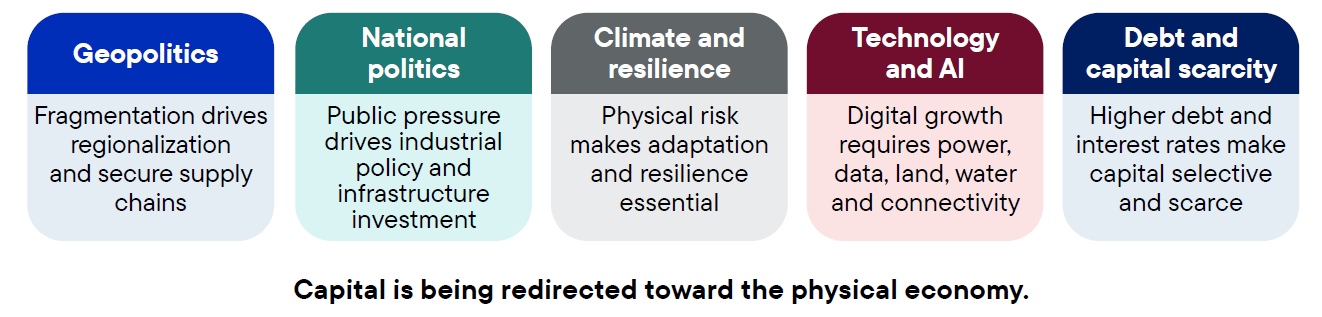
Several forces are driving that shift. Geopolitical fragmentation is pushing countries and companies to regionalize supply chains and secure critical inputs. Domestic political pressure is increasing the role of the state in industrial policy, defense, housing, energy and infrastructure. Climate change is turning adaptation into a capital-allocation requirement. Artificial intelligence (AI) and electrification are exposing the physical constraints behind digital growth, particularly power, grid capacity, land, water and logistics. At the same time, elevated public and private debt burdens limit the flexibility of governments and markets just as investment needs are rising.
Together, these forces point in the same direction: The future is likely to be more physical, more local, more power-intensive, more infrastructure-dependent and more exposed to scarcity. For investors, the opportunity is not simply to own “hard assets.” It is to identify the assets that sit inside essential economic systems and help those systems function under stress.
We describe this as systems-led investing. It starts with the systems under pressure—energy, data, housing, logistics, food, water, natural resources and social infrastructure—but moves quickly to the investment question: Which assets are scarce, essential and capable of improving system resilience? In this environment, real assets are not peripheral allocations. They are increasingly the physical foundations of economic resilience.
Franklin Real Assets brings together capabilities across infrastructure and functional real estate, enabling investors to access these opportunities through public markets, partnered private strategies and direct private investments. As the world moves from efficiency to resilience, many of the most important opportunities are likely to be found in the assets that make tomorrow’s economy possible.
From Efficiency to Resilience
For decades, investors were rewarded for allocating capital around the logic of efficiency. Production could be distributed globally. Supply chains could be stretched across borders. Inventories could be minimized. Capital could move freely. Energy security, logistics capacity, grid reliability and domestic industrial depth were often treated as background conditions rather than strategic constraints.
That era produced considerable benefits. It lowered costs, supported disinflation, expanded margins and allowed capital-light businesses to scale rapidly. The highest-value companies often appeared to be those furthest removed from the physical economy.
The assumptions that supported that world are weakening. Strategic competition is reshaping trade, technology, energy and capital flows. Domestic politics are pulling governments toward security, affordability and productive capacity. Climate change requires adaptation in real time. AI and electrification are increasing demand for physical capacity. Debt burdens are reducing flexibility just as investment requirements are rising.
The result is a transition from an efficiency regime to a resilience regime.
In an efficiency regime, the central question is: What is cheapest? In a resilience regime, the central question becomes: What is secure, available, durable and strategically necessary? That distinction matters because the answer increasingly lies in physical systems. The economy needs power that can be generated and delivered, data that can be processed and cooled, goods that can move through reliable corridors, housing where people and employers need it, and resources that can withstand volatility.
Efficiency will always matter. Investors will always care about cost, margin and return on capital. But efficiency is no longer the only organizing principle. A system that is low-cost but fragile may ultimately prove more expensive than one that is somewhat less efficient but more resilient. The last increment of reliability, redundancy or security can become extraordinarily valuable when a system is under stress.
The world is not simply rotating from one asset class to another. It is repricing the physical systems that make economic activity possible.
Five Forces, One Direction
The forces reshaping the investment landscape are often analyzed in isolation. Geopolitics is treated as foreign-policy risk. National politics is treated as electoral or regulatory risk. Climate change is treated as environmental risk. AI is treated as a technology opportunity. Debt is treated as a macroeconomic constraint.
That separation, however, misses the larger point. Each force redirects capital toward the physical economy, exposes bottlenecks in essential systems and increases the value of assets that secure critical flows. For investors, the implication is practical—the opportunity set is defined less by labels and more by the constraints an asset helps resolve.
Exhibit 1: Five Forces Are Redirecting Capital Toward the Physical Economy
Geopolitics: The Return of Geography
Geopolitics shapes the external environment in which economies operate—encompassing alliances, rivalries, trade routes, energy systems, military commitments, strategic resources and cross-border capital flows. For decades, many investors assumed that globalization was the default state of the world. Goods would move freely, shipping lanes would remain open, energy would be available, technology supply chains would deepen and capital would flow towards its highest risk-adjusted return.
That assumption is now less reliable.
Strategic competition is changing how governments and companies think about economic dependence. Semiconductors, critical minerals, energy infrastructure, ports, digital networks and defense supply chains are no longer viewed purely through a commercial lens. They are increasingly assessed through the lens of national and economic security. The question is no longer where production is cheapest, but whether supply can be trusted in a crisis.
This alters the value of location. In an efficiency-driven environment, location was often a cost variable. In a resilience-driven environment, location becomes a strategic consideration. Assets situated in secure jurisdictions, near critical demand centers, connected to reliable power, supported by public policy and embedded in resilient supply chains, may command a meaningful premium. Geography matters because physical proximity, legal certainty, resource access and alliance structures are becoming increasingly important determinants of investment outcomes.
National Politics: From Public Pressure to Private Investment
If geopolitics represents the external order, national politics represents the internal order. It is the way in which voters, governments and institutions respond to affordability pressures, industrial decline, migration, housing shortages, energy costs, infrastructure quality and economic insecurity.
This distinction matters. Geopolitics explains why countries want more secure supply chains. National politics explains why governments are increasingly willing to intervene to build them.
Across developed markets, voters are demanding greater visible domestic capacity. Housing shortages, energy affordability, industrial employment, national security and infrastructure quality have all become political issues of substance. In response, governments are deploying industrial policy, subsidies, procurement, regulation, public-private partnerships and permitting reform to direct investment.
For investors, national politics can convert public pressure into investable demand. Affordable housing, energy security, grid modernization, social infrastructure, water systems and strategic production are all areas where private capital may be invited to help address public challenges. The opportunity is meaningful, but it requires discipline. Assets linked to national priorities may benefit from policy support, but they may also face heightened scrutiny, regulation and expectations around affordability, reliability and social license.
Climate and Resilience: Adaptation Becomes Capital Allocation
Climate change is frequently discussed as an energy transition story. That framing remains important, but it is too narrow. Climate change is also an adaptation story, a physical-risk story and a resilience story.
Heat events, flooding, wildfire, drought, storms, water stress and insurance pressure are already altering the economics of infrastructure, buildings, agriculture, utilities and public finance. The question is no longer solely how to reduce future emissions. It is also how to protect assets and communities from risks that are already present.
This turns resilience into a capital-allocation imperative. Capital is needed to harden grids, improve water systems, adapt buildings, strengthen food logistics and manage productive land against water stress, soil degradation and climate variability. The investable question is not only which assets are exposed to climate risk, but which assets reduce that risk for the systems around them.
The opportunity is not simply defensive. Resilience spending can create durable demand for assets that address real physical challenges. A grid upgrade that reduces outages, a water asset that improves supply reliability, housing designed to reduce energy costs, or a natural capital strategy that protects agricultural productivity can all create long-term value by strengthening the systems upon which economies and communities depend.
Technology and AI: Digital Growth Requires Physical Capacity
Artificial intelligence may be the most widely discussed technology story of the current decade, but its investment implications extend far beyond software. AI is experienced through models and applications, yet its ability to scale depends on physical inputs: secure power, data centers, cooling, land, water, fiber, backup systems, substations, transmission capacity and permitting approvals.
The same is true of electrification more broadly. Electric vehicles, industrial automation, advanced manufacturing and digital infrastructure all require a larger, more reliable and more complex power system. The next phase of technology growth may be constrained not by software ambition, but by power availability, grid interconnection, equipment lead times, site control and local planning approvals.
This represents a meaningful shift in investment thinking. In the previous technology cycle, the scarce assets were often intangible: code, platforms, intellectual property, networks and data. In the next cycle, the scarce layer may increasingly be physical. The winners may be determined not only by who develops the best model, but by who can secure the infrastructure required to deploy it at scale.
The economy is not becoming less physical. It is becoming physical in new ways.
Debt and Capital Scarcity: The End of Easy Money
The transition to a more resilient economy will require substantial investment at a time when public and private sector balance sheets are more constrained than they have been for some years. For much of the post-financial-crisis period, low interest rates and abundant liquidity supported long-duration assets, financial engineering, elevated leverage and asset-price appreciation. Many investors grew accustomed to an environment in which capital was readily available and refinancing risk was manageable.
That environment has changed materially. Higher debt burdens, elevated interest rates, inflation volatility and fiscal pressure are reducing the flexibility of governments and companies alike. Capital remains available, but it is more expensive and more selective in its allocation.
This does not weaken the case for real assets; it reinforces the requirement for investment discipline. In a capital-constrained environment, investors should place a higher premium on durability, essentiality, cash-flow quality, balance-sheet discipline, liquidity management and operating control. Assets that address critical-system needs may continue to attract capital even when broader funding conditions are restrictive. Assets that depend principally on low-cost leverage or capitalization-rate compression may prove more vulnerable.
Elevated debt burdens may also increase the need for governments to draw on private capital to fund public priorities. Fiscal capacity alone is unlikely to be sufficient to finance the infrastructure required for a more resilient economy. This creates opportunities for patient capital, but only where system-need, risk allocation and return potential are appropriately aligned.
Systems-Led Investing
If the five secular forces described above point in the same direction, investors need a framework that connects them. Traditional asset-class investing begins with categories. Thematic investing begins with narratives. Systems-led investing begins with a different question: What essential economic system is under pressure, and what assets are required for that system to function?
This distinction matters. Themes can become broad and imprecise. Systems are concrete. They have physical assets, operating constraints, regulatory structures, cash flows, counterparties, communities and bottlenecks. They require capital and can be measured, underwritten and improved.
Exhibit 2: Relieve the Constraint to Unlock the System
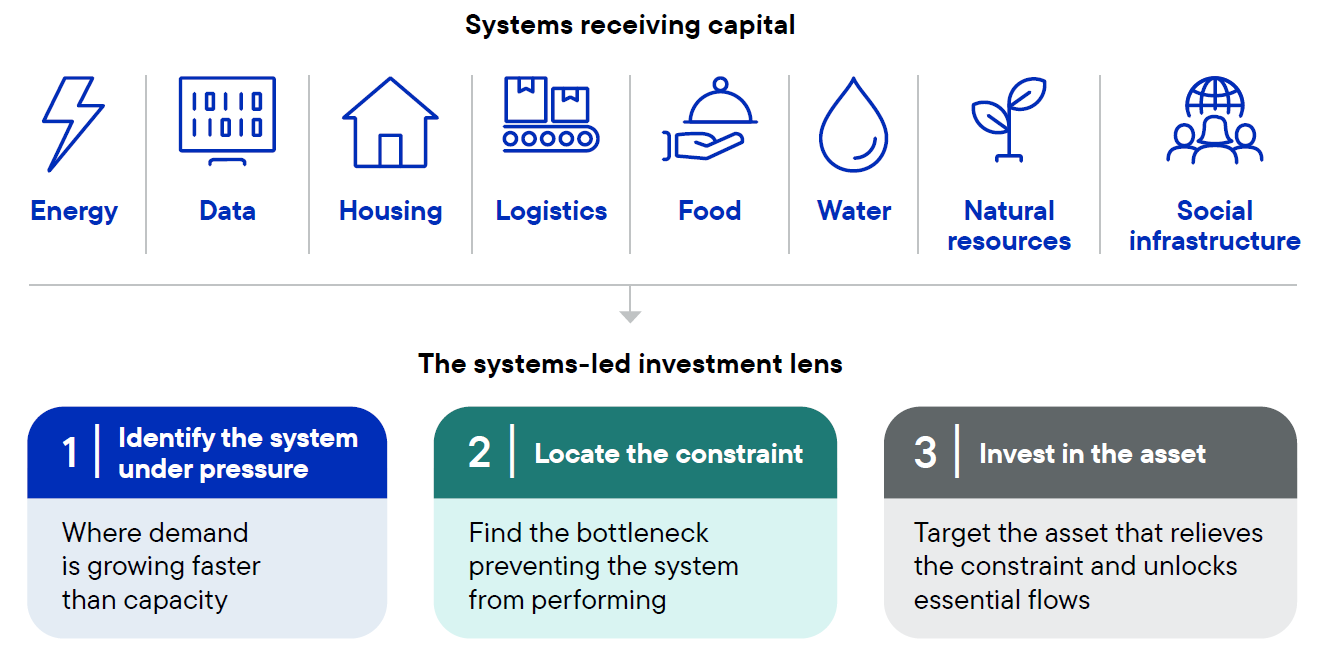
In energy, the opportunity is not simply “energy transition.” It is the requirement for reliable, affordable and secure systems capable of supporting electrification, AI-driven demand, manufacturing expansion and climate adaptation. The relevant assets should be assessed by the constraint they relieve, whether that is generation, transmission, storage, land access, fuel logistics or demand-side flexibility.
In data infrastructure, the opportunity is not simply “AI.” It is the physical system required to make AI usable at scale. Power availability, grid access, cooling, fiber connectivity, land and permitting can matter as much as demand. A data center without secure power is not a growth asset; a site with confirmed power, interconnection rights and approvals may become strategically significant.
In housing and social infrastructure, the opportunity is not simply “real estate.” It is the requirement for functional assets that support communities, workers and public priorities. Affordable and essential housing, social infrastructure and land connected to essential services can create value because they resolve real economic constraints, not because they fit neatly within a property category.
In food, water and natural resources, the opportunity is not simply “farmland” or “timber.” It is the role of productive land, water access, storage, processing capability and biological resilience in a world of climate volatility and supply-chain risk.
The central underwriting question is therefore: What essential flow does the asset secure?
Assets that support the reliable provision of power, data, housing, food, water, logistics or social infrastructure may be better positioned over the long term than those whose value depends primarily on prevailing financial conditions. In a resilience regime, the capacity to secure and sustain essential flows is likely to become increasingly valuable.
Investing in the Systems that Matter
Franklin Real Assets brings together capabilities across the real assets landscape to help clients navigate the shift from efficiency to resilience. The platform is not defined by asset labels alone. It is defined by a view of where long-term opportunity lies in the physical systems that make economies function.
That view has practical implications for how investors access these opportunities.
First, we believe investors need breadth. The systems under pressure do not fit neatly within a single asset class. Energy, AI infrastructure, housing affordability, food security and water resilience each require different combinations of infrastructure, land, operating expertise, policy engagement and capital structure. A narrow lens risks missing the connections between these systems.
Second, investors need flexibility. Some opportunities are best accessed through public markets, where listed real-asset securities can provide liquidity and efficient exposure to long-term structural tailwinds. Others require partnered private strategies, co-investments, secondaries or strategic industry relationships. Still others require direct private investment, development capital or specialized operating capability. The form of capital should be matched to the nature of the opportunity.
Third, investors need portfolio construction that reflects their specific objectives. Institutions are reassessing resilience in a world of inflation volatility, geopolitical risk and uncertain policy response. Wealth investors are increasingly seeking access to private markets, but they require education, transparency, reporting and structures aligned to their liquidity needs. Franklin Real Assets connects client capital to real-asset opportunities across risk levels, liquidity profiles and asset life cycles.
The common thread is systems relevance. The most attractive assets are likely to be those that secure essential flows, relieve bottlenecks or increase resilience. That focuses the investment discussion on practical questions: Where power will come from, where data will be processed, where people will live, how goods will move, and how economies will remain productive under stress.
Portfolio Implications
The shift from efficiency to resilience has material implications for portfolio construction. We believe the answer is not simply to increase real-assets allocations. It is to underwrite real assets differently.
Essentiality matters more. In a low-interest-rate, efficiency-driven environment, many assets benefited from abundant liquidity and rising valuations. In a resilience-driven environment, the premium may shift towards assets that provide necessary services, control scarce inputs or support critical systems. Essentiality does not eliminate risk, but it can provide a stronger foundation for long-term demand.
Investing in bottleneck relief can create value. The most attractive opportunities may be the assets that unlock capacity elsewhere—a grid connection that enables digital infrastructure, a water asset that supports housing development, a logistics node that improves supply-chain reliability, or a land position that enables broader infrastructure delivery. Scarcity often manifests first as a constraint, and constraints can become investable opportunities.
Liquidity should be matched to opportunity type. Public markets can provide efficient liquid access to real-asset themes. Private markets can provide exposure to assets and partnerships that may not be accessible publicly. Semi-liquid structures can help bridge the needs of wealth investors seeking private-market access with more flexible liquidity requirements. The objective is not to favor one format universally, but to match the structure to the asset, the client’s needs and the investment horizon.
Operating capability matters increasingly. As real assets become more strategically important, execution quality becomes a more significant determinant of outcomes. Permitting, construction management, stakeholder engagement, regulatory navigation, financing, community impact and asset management can determine outcomes. In systems-led investing, the asset is not simply a financial instrument. It is part of a functioning economic system.
The most compelling opportunities may be those where portfolio resilience and real-economy resilience reinforce each other—assets that improve the functioning of essential systems while also offering durable income, inflation sensitivity, diversification or long-term capital growth.
Conclusion: What Makes Growth Possible
The defining investment question of the next decade will not simply be where growth occurs. It will be what enables that growth.
Across energy, data, housing, logistics, food, water and natural resources, the assets that make economies function are becoming increasingly valuable. This is not because the world has abandoned innovation or digital growth. It is because innovation and growth increasingly depend on physical capacity, secure inputs, resilient systems and disciplined capital formation.
Taken together, the forces reshaping the global economy point toward the same conclusion: The future is likely to be more physical, more local, more power-intensive, more infrastructure-dependent and more exposed to scarcity. Investors who understand that shift may be better positioned to identify where capital is needed and where value may accrue.
Franklin Real Assets provides investors with access to these opportunities through a broad platform spanning public markets, partnered private strategies and direct private investments across the real-asset landscape. The objective is not simply to gain exposure to the real-asset class but to invest in the essential systems that underpin economic growth, resilience and the functioning of modern society. As the world shifts from prioritizing efficiency to placing greater emphasis on resilience, many of the most significant investment opportunities may be found in the assets that secure essential flows, relieve critical bottlenecks and provide the foundations for tomorrow’s economy.


Related Perspectives

Global Infrastructure Value Strategy Commentary Q3 2026
Establishing Conditions for Stronger Future Earnings
Utilities generally recover prudently incurred costs such as higher interest rates as regulators recalibrate allowed returns to reflect prevailing financing conditions.
Disclaimer
WHAT ARE THE RISKS
All investments involve risks, including possible loss of principal.
Equity securities are subject to price fluctuation and possible loss of principal.
Small- and mid-cap stocks involve greater risks and volatility than large-cap stocks.
Investment strategies which incorporate the identification of thematic investment opportunities, and their performance, may be negatively impacted if the investment manager does not correctly identify such opportunities or if the theme develops in an unexpected manner. Focusing investments in the health care, information technology (IT) and/or technology-related industries carries much greater risks of adverse developments and price movements in such industries than a strategy that invests in a wider variety of industries.
An investment in private market investments is suitable only for investors who can bear the risks associated with them (such as private credit and private equity) with potential limited liquidity. Shares will not be listed on a public exchange, and no secondary market is expected to develop.
IMPORTANT LEGAL INFORMATION
This material is provided for general informational purposes only and should not be considered individualized investment advice, a recommendation or a solicitation to adopt any investment strategy. It does not constitute legal or tax advice. Franklin Templeton accepts no liability for losses arising from use of this material.
The views expressed are those of the investment manager as of the publication date and may change without notice. These opinions and analyses are based on certain assumptions, including market conditions that may change. They may differ from those of other portfolio managers or from the firm as a whole.
This material is not intended to provide a complete analysis of all material facts regarding any country, region or market. No assurance can be given that any forecast, projection or prediction regarding economies or financial markets will be realized. References to specific securities are for illustrative purposes only and should not be interpreted as recommendations or a solicitation to buy, sell or hold any security.
Any research or analysis in this material has been prepared by Franklin Templeton for its own purposes and is provided incidentally. While the information included is believed to be reliable, its accuracy and completeness cannot be guaranteed, and it is subject to change without notice.
Past performance does not guarantee future results, or any profit or gain. All investments involve risks, including possible loss of principal.
Franklin Templeton offers environmental, social and governance (ESG) capabilities, though not all strategies or products incorporate ESG as part of the investment process.
Investment strategies and services may not be available in all jurisdictions. Please consult your financial professional or Franklin Templeton contact for further information.
Brazil: Issued by Franklin Templeton Brasil Ltda. Canada: Issued by Franklin Templeton Investments Corp. Offshore Americas: In the United States, this publication is made available by Franklin Templeton. United States: Issued by Franklin Templeton. Investments are not FDIC insured; may lose value; and are not bank guaranteed.
Europe: Issued by Franklin Templeton International Services S.à r.l., 8A, rue Albert Borschette, L-1246 Luxembourg. Poland: Issued by Templeton Asset Management (Poland) TFI S.A.; Rondo ONZ 1; 00-124 Warsaw. Saudi Arabia: Issued by Franklin Templeton Financial Company, KAFD, Building 3.09, Office No. 8018, Level 8, Saudi Arabia. Regulated by CMA. License no. 23265-22. South Africa: Issued by Franklin Templeton Investments SA (PTY) Limited, which is authorised by the FSCA as a Financial Service Provider (No.44475). Switzerland: Issued by Franklin Templeton Switzerland Ltd, Talstrasse 41, CH-8001 Zurich. Middle East & Africa (ex South Africa): Issued by Franklin Templeton Investments (ME) Limited, which is regulated by the Dubai Financial Services Authority. Address: Franklin Templeton, The Gate, East Wing, Level 2, Dubai International Financial Centre, P.O. Box 506613, Dubai, U.A.E. Tel: +971(04) 428 4100.
United Kingdom: Issued by Franklin Templeton Investment Management Limited (FTIML), registered office: Cannon Place, 78 Cannon Street, London EC4N 6HL.
Australia: Issued by Franklin Templeton Australia Limited (ABN 76 004 835 849) (Australian Financial Services License Holder No. 240827), Level 47, 120 Collins Street, Melbourne, Victoria 3000. Hong Kong: Issued by Franklin Templeton Investments (Asia) Limited. Japan: Issued by Franklin Templeton Japan Co., Ltd. South Korea: Issued by Franklin Templeton Investment Advisors Korea Co., Ltd. Malaysia: Issued by Franklin Templeton Asset Management (Malaysia) Sdn. Bhd. & Franklin Templeton GSC Asset Management Sdn. Bhd. Singapore: Issued by Templeton Asset Management Ltd. (UEN) 199205211E.