Global Growth Strategy Commentary Q2 2026
Asia, Europe Flex Tech Muscles
Key Takeaways
- Global equities rebounded sharply, led by AI-linked technology and industrials stocks as well as emerging markets.
- The Strategy delivered double-digit absolute returns but underperformed its benchmark due to a lack of exposure to a handful of high-flying semiconductor stocks.
- We increased exposure to AI infrastructure beneficiaries across semiconductors, storage, networking, optical equipment and data centre connectivity where supply constraints and pricing power are emerging.
Market Overview
Global equities rebounded in the second quarter as progress towards a resolution of the Iran conflict and an ongoing artificial intelligence (AI) infrastructure buildout led to double-digit gains across U.S., non-U.S. developed and emerging markets. The core benchmark MSCI All Country World Index (ACWI) rose 13.6% while the S&P 500 Index advanced 13.8%, the MSCI EAFE Index added 9.5% and the MSCI Emerging Markets Index jumped 22.6%.
Global growth stocks regained leadership over value stocks, with the MSCI ACWI Growth Index gaining 18.4% to outperform the MSCI ACWI Value Index (+9.3%) by over 900 basis points (Exhibit 1). Growth has now closed most of the performance gap year-to-date and leads value for the trailing 12 months.
From a regional standpoint, emerging markets (+22.6%) outperformed the global benchmark, while North America (+13.4%), Japan (+12.9%) and Europe Ex-U.K. (+11.5%) also produced double-digit gains. The United Kingdom (+2.9%) and Asia ex Japan (+2.6%) lagged the index. Emerging markets were lifted by soaring demand for semiconductor stocks in South Korea (+85.4%) and Taiwan (+47.2%).
Sentiment for chip makers was equally zealous outside Asia, with semiconductors leading an information technology (IT) sector that rose 37.5% for the quarter. While the ClearBridge Global Growth Strategy was supported by a range of semiconductor and AI infrastructure holdings across Asia and Europe, it underperformed the MSCI ACWI benchmark primarily due to a lack of exposure to several chip names that soared over 100% for the quarter.
We view generative AI as no longer just about the most visible technology platforms — it is becoming a global supply chain bottleneck story. The scale of AI capital spending is overwhelming the existing manufacturing base for advanced computing, creating constraints across multiple IT product categories. These constraints have created an advantageous supply/demand environment for key suppliers that were the Strategy’s best quarterly performers.
Exhibit 1: MSCI Growth vs. Value Performance
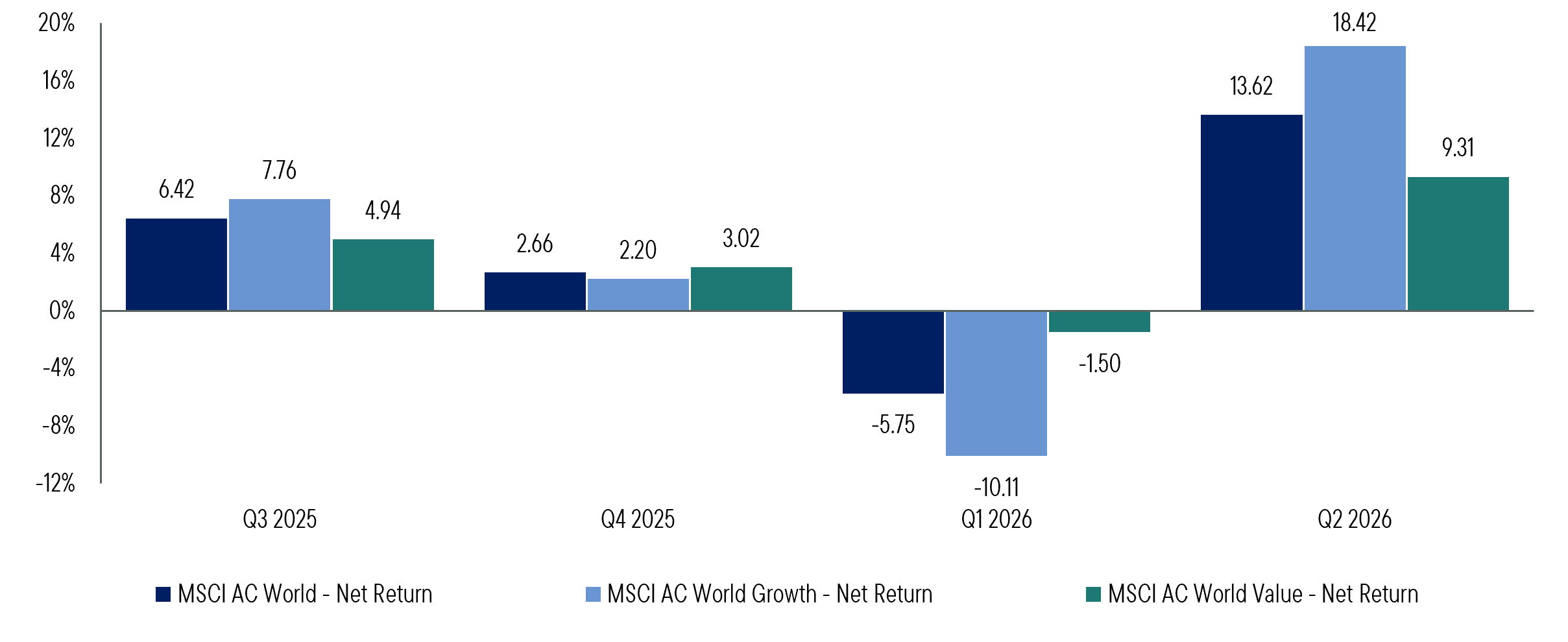
As of June 30, 2026. Source: FactSet. Currency: AUD.
Shares of system-on-a-chip maker MediaTek nearly tripled during the quarter as the Taiwanese company saw encouraging results from its emerging AI accelerator chips business for customers including Alphabet. South Korea high-bandwidth memory maker Samsung Electronics, Dutch Semiconductor capital equipment makers ASM International and Japan chip manufacturing inspection systems firm Lasertec also delivered strong gains. Taiwan Semiconductor, the world’s largest foundry for high-end chips, was up strongly as it continued to gain pricing power due to its near monopoly on production and advanced technology.
Related to the AI buildout, Italian fibre optic cable manufacturer Prysmian benefitted from industry supply constraints, allowing the company to raise prices as demand continues to outpace supply. U.S.-based Vertiv, a provider of power, thermal management and digital infrastructure solutions, continued to benefit from robust data centre spending.
Our AI holdings offset idiosyncratic weakness among a handful of stocks. U.S. video streaming platform Netflix declined as investors worried about slowing user engagement and were disappointed the company did not raise full-year guidance despite another solid quarter. Additionally, U.S. exchange operator Intercontinental Exchange was pressured by emerging competition in the derivatives market and weakness in its mortgage technology business.
The Strategy was also hurt by not owning memory names Micron Technology, SK Hynix and CPU maker Intel, all of which saw their share prices more than triple in the period.
Portfolio Positioning
While a focus on diversification across our three buckets of growth companies prevents us from owning every name that thrives in a momentum market like the current one, we feel good about the broad exposure we have established across AI infrastructure. Our recent activity has been focused on increasing exposure in areas where scarcity or service bottlenecks are creating pricing power and/or new sources of demand. Several of the largest additions among our 23 new positions during the second quarter supported this AI theme.
One of the most visible areas where supply/demand imbalance is enabling companies to raise prices is in semiconductors. Central processing units (CPUs) are playing increasing roles as more companies develop cloud capabilities to host AI workloads and offer AI agents, a trend benefitting new addition Advanced Micro Devices, based in the U.S. New additions in analogue chip makers such as Texas Instruments in the U.S. and Germany’s Infineon are also benefiting from AI-driven demand for power management circuits to regulate voltage for specific server workloads, enabling Infineon to push through two price hikes in the second quarter alone.
The scale of AI capital spending is creating constraints across other IT product categories including storage, networking and optical infrastructure. This is benefitting Seagate Technology, a U.S.-based key supplier of the hard drives supporting AI data infrastructure, where demand for low-cost, high-capacity storage is structurally rising.
Canada’s Celestica manufactures “white box” networking switches that can be paired with chips and software from other vendors. These systems offer lower hardware costs and greater flexibility, enabling hyperscalers to customise their AI networking infrastructure and use it as a competitive differentiator.
Finland’s Nokia has transformed itself over the last decade from primarily a wireless and telecom provider into a leading supplier of long-haul optical and lasers that enable high-speed data connectivity over longer distances. With key rival Ciena at capacity, Nokia is expanding its own production capabilities fivefold to meet accelerating demand for connecting multiple data centres into AI clusters. U.K.-based technology conglomerate Halma also has a rapidly growing optical photonics business that allows hyperscalers to enhance the connectivity of AI chips and servers within and across data centres. The company’s design and installation business has doubled in revenue over the last two years and is projected to grow approximately 30% annually going forward.
We exited 23 positions during the quarter with the largest being Microsoft, as the cloud hyperscaler and enterprise software maker has seen its weighting decline in the rebalancing of growth benchmarks, Swedish mining equipment maker Sandvik and Germany utility E.On. We also exited Chinese digital conglomerate Tencent, an out-of-benchmark position that helped fund the increase in our Japan exposure.
Outlook
The U.S. remains by far our largest weight in the portfolio, and although we are underweight the region versus the benchmark, we maintain broad exposure across both mega cap technology companies as well as areas less correlated to AI demand, including pharmaceuticals and consumer staples. We also see several structural drivers supporting equities outside the U.S., including continued attractive valuations, improving earnings growth as geopolitical tensions ease and increasing flows toward international stocks as broadening increases. The biggest driver of this momentum is a global AI capital spending cycle that is benefiting companies across Japan, South Korea, Taiwan and parts of Europe. As active investors attuned to secular growth trends, we are willing to make substantial changes to improve our participation in such trends. While we saw some early signs of success from these efforts in the second quarter, we acknowledge that not all portfolio holdings will be immediately recognised for their growth attributes. This is where diversification and duration can work to our advantage.
Regionally, Japan has developed into our highest-conviction non-U.S. opportunity. Its emergence from decades of deflation, a more pro-business policy environment and ongoing Tokyo Stock Exchange governance reforms are creating a multi-year improvement in corporate profitability and shareholder returns. These structural changes are driving higher returns on equity through balance sheet optimisation, share buybacks, improved capital allocation and stronger corporate governance. We have increased our exposure, particularly within industrial companies benefitting from electrification, the energy transition and defence spending.
Looking ahead, we expect AI to evolve beyond today’s infrastructure beneficiaries into a much broader enterprise productivity theme. While the portfolio continues to invest across the AI supply chain — including semiconductor equipment, electrical infrastructure, utilities, cable manufacturers and other “picks-and-shovels” businesses — we believe the next phase of AI will be driven by adoption across financial services, health care, manufacturing and other industries, creating significant productivity gains and new business models.
Portfolio Highlights
During the second quarter, the ClearBridge Global Growth Strategy underperformed its MSCI ACWI benchmark. On an absolute basis, the Strategy produced positive gains across six of the nine sectors in which it was invested (out of 11 total). The primary contributors were the IT and industrials sectors, while consumer staples and materials were the main detractors.
Relative to the benchmark, overall sector allocation contributed to performance but was offset by negative stock selection effects. In particular, selection in the IT, consumer discretionary, communication services, consumer staples and financials sectors detracted from performance, as did overweights to health care and consumer staples. On the positive side, selection in health care, a lack of exposure to energy, an overweight to IT and underweights to financials and materials supported performance.
On an individual stock basis, the greatest detractors from relative returns were Netflix in communication services, Intercontinental Exchange in financials, Honeywell International in industrials as well as not holding Micron Technology and SK Hynix in IT. The largest contributors to relative returns were MediaTek, Samsung Electronics, ASM International and Taiwan Semiconductor in IT as well as Prysmian in industrials.
In addition to the transactions mentioned above, other notable moves included purchases of SK Square, Mitsubishi Electric and Canadian Pacific Kansas City in industrials, Novartis in health care and Anheuser-Busch InBev in consumer staples. We also closed positions in Tesco in consumer staples, AppLovin and Synopsys in IT.




Related Perspectives

Global Infrastructure Income Strategy Commentary Q3 2026
Utilities Look Attractive as Rates Rise
Regulated rate-base growth, electrification, grid investment and data center demand support infrastructure, with inflation-linked tariffs and contractual escalators helping preserve real asset values over time.